


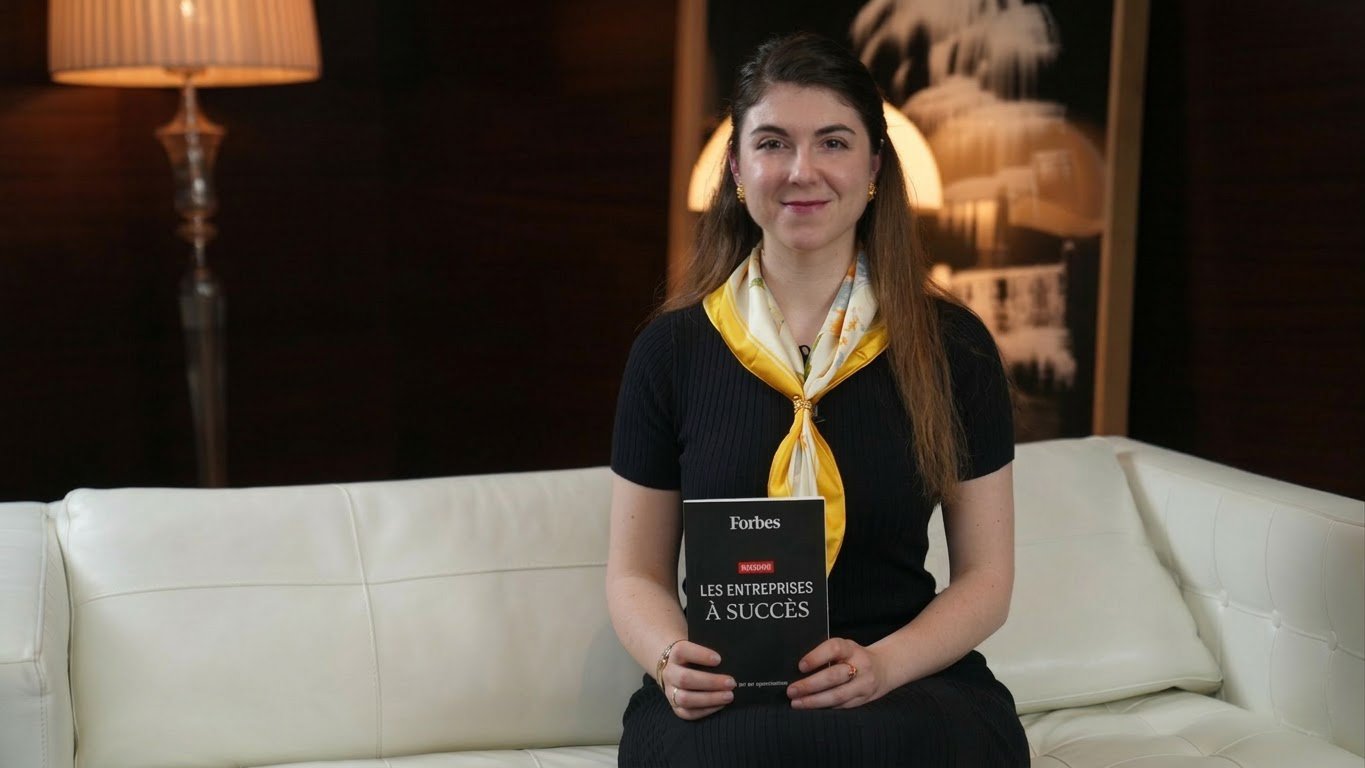
| There is a particular kind of room that stops you at the threshold. Not because it announces itself loudly — quite the opposite. It draws you in with something subtler: a quality of light, a proportion that settles the body, a material chosen with such precision that it seems inevitable. These are the rooms of Irina Lungu.Paris-based architect and founder of IL Architecture, Lungu operates at the intersection of structural rigour and emotional intelligence — designing private residences, boutique hotels, and cultural institutions for clients who understand that true luxury is never accidental.We met her in the 6th arrondissement on a grey autumn morning. Over strong espresso and the gentle sounds of the city recalibrating itself, she spoke about the architecture that shaped her, the craftsmen who inspire her, and why she believes the best spaces are designed to be felt long before they are understood. | “What looks effortless is never accidental. It’s precision in materials, proportions, and execution.” |
“Preservation is not nostalgia. It is continuity, elevated for contemporary living.” — IRINA LUNGU, IL ARCHITECTURE
PART ONE
Paris — A City of Layers
Jennifer Kershaw: Paris is often described as a city of layers. As someone living and creating here, what does it represent to you architecturally?
Paris is unlike any other city in the world. What fascinates me is not simply the idea of layers, but how those layers coexist so seamlessly that you almost forget time. There is no strict division between past and future — the future fits naturally within the past.
Designing here means negotiating heritage, regulation, proportion, and context every single day — particularly in high-end renovations and landmark buildings, where precision is non-negotiable. Working in Paris has refined my ability to operate within strict frameworks while delivering spaces that feel effortless, luxurious, and timeless.
Preservation is not nostalgia. It is continuity, elevated for contemporary living.
Jennifer Kershaw: What first drew you to architecture? Was it a place, a moment, a feeling rather than a building?
It was always a place — and the way a place makes you feel. I have always been sensitive to atmosphere. As a child, I noticed how light enters a room, how materials change the mood, how proportions influence comfort.
Later, my love for mathematics and physics gave structure to that sensitivity. I realised that architecture is where emotion and logic coexist. It is not only about designing walls — it is about designing how life unfolds within them.
That balance still defines my work today.
“Architecture is not only about designing walls — it is about designing how life unfolds within them.” — IRINA LUNGU, IL ARCHITECTURE
Jennifer Kershaw: Is there a neighbourhood, a street, or an everyday Parisian detail that quietly inspires you — something most people might overlook?
I’m often drawn to the 6th arrondissement — not for the postcard Paris, but for the Paris behind the doors. Ateliers. Textile makers. Antique dealers. Craftsmen working in silence behind historic façades.
That world taught me my favourite definition of luxury: what looks effortless is never accidental. It is precision in materials, proportions, and execution.
I once discovered a one-of-a-kind malachite chess table. The stone had such depth that it didn’t just “belong” in a room — it commanded it. I designed an entire tea corner around it: the light, the seating, the textures, even the pause in the day the space was meant to create. Paris inspires me through details that carry meaning, and quietly turn a place into an experience.
❖ ❖ ❖
PART TWO
Influences & Emotion
Jennifer Kershaw: Which architects, artists, or designers most influence how you think about space and form?
Early in my career, I was strongly influenced by Swiss and Japanese architecture. From Switzerland, Peter Zumthor shaped my understanding of material and silence — how precision can generate profound emotion. Herzog & de Meuron influenced me through their craft-driven rigour and contextual intelligence.
From Japan, SANAA’s clarity, Sou Fujimoto’s lightness, and Junya Ishigami’s spatial delicacy taught me how void, structure, and atmosphere can coexist.
Over time, my influences evolved toward atmosphere — how light, texture, and materiality shape emotion. Working on institutional and cultural projects reinforced my belief that every line must be justified: coherent, durable, and built to endure.
Today, what guides me is not a style. It is a method: structural discipline with emotional sensitivity.
Jennifer Kershaw: Do you believe architecture should evoke emotion? And if so, which emotions matter most to you?
Absolutely. Through my work on public and cultural buildings, I’ve learned that if a space provokes nothing, it doesn’t truly serve people. A public building must invite curiosity, presence, belonging.
Before designing, I observe behaviour: how people circulate, where they pause, what makes them feel safe. Architecture shapes behaviour.
In luxury architecture, emotion is not spectacle — it is coherence. True sophistication is subtle; it’s felt before it’s seen.
The emotions that matter most to me are simple: joy, light, and peace. Not spectacle, but harmony.
“In luxury architecture, emotion is not spectacle — it is coherence. True sophistication is subtle; it’s felt before it’s seen.” — IRINA LUNGU, IL ARCHITECTURE
❖ ❖ ❖

PART THREE
Process, Intuition & the Future
Jennifer Kershaw: What role does intuition play in your creative process? Do you design more from feeling or from structure?
Intuition leads the beginning. A site always offers a trigger — light, volume, a view, an atmosphere. I let the space speak before imposing structure.
I often start with feeling, then logic reveals itself. With experience, intuition becomes precise, as if an invisible structure appears. Intuition opens the door. Structure makes the vision durable and buildable.
And in high-end projects, feeling is always followed by rigorous validation — structural, regulatory, and financial.
Jennifer Kershaw: Paris moves at a particular rhythm. How does the city’s pace — the cafés, the walkability, the compact living — shape the way you imagine spaces?
Paris changes rhythm constantly, depending on time, season, even day of the week. In the morning it is precise and efficient; in the evening, it softens, becomes intimate. Between those two states, the city recalibrates continuously.
This influences how I design. Parisian spaces are compact and layered — every square metre must be intelligent. Flow must feel effortless. My work on public and cultural projects reinforced this idea of choreography: movement, pause, gathering, solitude. I apply the same logic to boutique hotels and private residences, where circulation must feel natural yet intentionally designed.
This rhythm also shapes how I work with people. I’m more like water: I adjust, I flow, I find the right path.
Jennifer Kershaw: If you had to describe Parisian architecture in just three words — what would they be, and why?
Elegance. Sobriety. Timelessness.
Paris does not shout or chase trends. Even contemporary architecture here carries measured dignity. That restraint is what makes the city eternal. It is a quiet power — discreet, but unmistakable — and it deeply informs my work.
Jennifer Kershaw: Looking ahead, what are you most curious about exploring — conceptually rather than professionally?
I’m interested in how architecture changes across cultures — how people inhabit space through privacy, ritual, light, and density. I’m interested in cultural psychology, not just geography.
Because architecture is not only physical; it is neurological and emotional. Space shapes behaviour, attention, connection. I’m also drawn to expanding IL Architecture internationally — through refined private residences, boutique hospitality projects, and distinctive cultural spaces for clients who value discretion and architectural intelligence.
Jennifer Kershaw: And finally — what advice would you offer to young people drawn to architecture but perhaps intimidated by its traditions?
Learn the rules. Study history. Understand proportion. Analyse structure.
When you understand the logic, tradition stops being intimidating — it becomes a foundation. The goal is not to copy the past, but to use it intelligently to build something new.
Mastery gives freedom. And in luxury architecture, freedom must rest on deep knowledge.
EDITOR’S NOTE
Irina Lungu’s work through IL Architecture spans high-end private residences, boutique hospitality, and cultural institutions across Paris. Her practice is defined by a singular belief: that a truly luxurious space is one where every decision — structural, material, atmospheric — has been made with absolute intention. The result is architecture that does not perform, but endures.
— Jennifer Kershaw
