


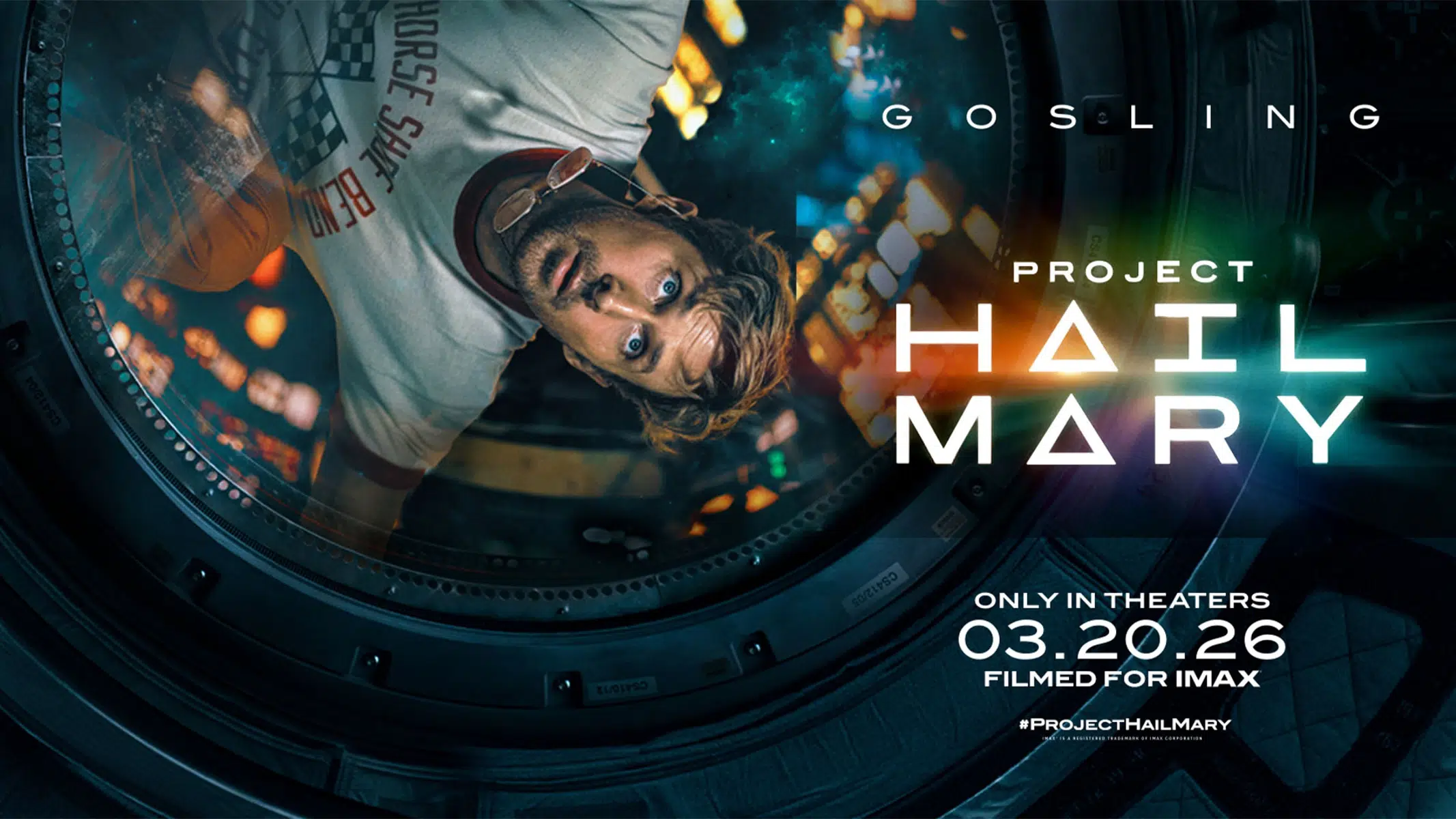
There is a moment in Andy Weir’s novel Project Hail Mary — a moment that readers who have finished the book will never forget — where everything the story has been quietly building toward suddenly crystallizes into something so unexpected, so emotionally overwhelming, that you have to put the book down and simply sit with it. That moment is coming to the big screen on March 20, 2026 with the much-anticipated Project Hail Mary movie 2026. And if the film delivers even half of what the source material promises, it will be the defining cinematic event of the year.
Project Hail Mary is the third novel from Andy Weir, the author who gave science fiction its great popular renaissance with The Martian in 2011 — a book that proved, against all conventional publishing wisdom, that rigorous, joyful hard science could sell millions of copies and become a blockbuster film starring Matt Damon. Project Hail Mary, published in 2021, does everything The Martian does and then quietly, devastatingly goes somewhere else entirely.
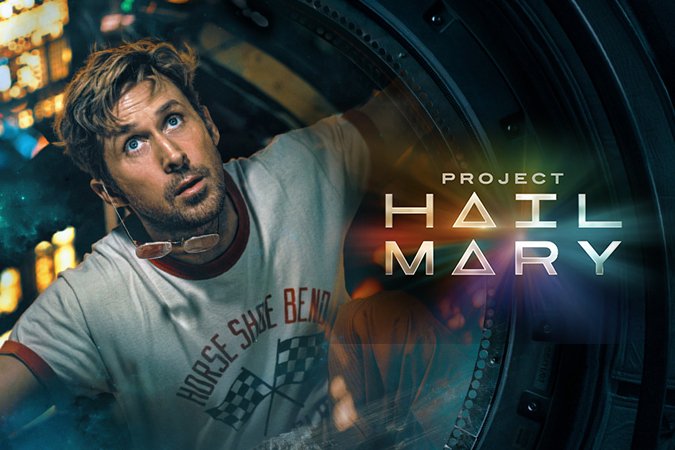
Ryan Gosling stars as Ryland Grace, a middle-school science teacher who wakes up alone on a spacecraft with no memory of who he is, how he got there, or where he’s going. As his memory slowly, painfully returns, so does the terrible weight of what he has been sent to do: travel light-years from Earth to solve the riddle of Astrophage, a microscopic organism that is consuming the sun’s energy and, if left unchecked, will eventually extinguish all life on Earth. He is the last chance humanity has. He doesn’t remember that yet. When he does, it doesn’t get easier.
WHAT IS PROJECT HAIL MARY ABOUT?
At its surface, Project Hail Mary is a survival story — one man, alone in deep space, against impossible odds. In that sense it shares DNA with The Martian, which famously followed astronaut Mark Watney’s resourceful, darkly comic fight for survival on a hostile Mars. But where The Martian was fundamentally a story about competence triumphing over disaster, Project Hail Mary is something more interior, more melancholy, and ultimately more profound.
Ryland Grace wakes up to find his two crewmates dead. He has no idea where he is. He has no idea who he is. The ship’s AI dutifully feeds him, nurses him back to health, and provides data — but no answers. The answers come back to him in fragments: flashes of memory, pieces of a life, a career, a mission he apparently volunteered for knowing he would almost certainly never return home.
The mission, designated the Hail Mary — named after the desperate, last-resort American football throw — is humanity’s final gamble. Scientists on Earth have detected Astrophage: a single-celled organism that feeds on stellar energy, reproduces at an exponential rate, and has already dimmed the sun by a measurable fraction. In a matter of decades, if nothing is done, the sun’s output will drop enough to trigger catastrophic climate collapse. The Hail Mary spacecraft has been sent to Tau Ceti, a nearby star that shows signs of Astrophage infestation — but also signs of something else. Something that suggests Tau Ceti’s solar system may hold the answer.
What Ryland Grace finds when he gets there is the part of this story that cannot, and should not, be spoiled here. Suffice it to say: he is not alone. And what follows is one of the most genuinely moving relationships in modern science fiction — rendered, in the novel, with such intelligence and warmth that readers describe it as a singular experience. The question for the film is whether that relationship — which presents unique technical and narrative challenges for any adaptation — can be translated to the screen with its emotional power intact.
“He is the last chance humanity has. He doesn’t remember that yet. When he does, it doesn’t get easier.”
RYAN GOSLING AS RYLAND GRACE: THE RIGHT MAN FOR THE MISSION
Casting the right actor for Ryland Grace was never going to be straightforward. The character spends the vast majority of the novel — and presumably the film — entirely alone, with no human being to act against. He has to be compelling without a scene partner. He has to make advanced astrophysics feel viscerally exciting. He has to make you laugh, and then, at precisely the right moment, make you ache.
Ryan Gosling is, on reflection, an inspired choice. His career has been defined by performances of extraordinary interior quality — by the ability to suggest depths of thought and feeling while appearing almost preternaturally still. From Drive to Blade Runner 2049 to his Oscar-nominated turn in Barbie, Gosling has shown a rare facility with silence: the ability to make an audience feel what a character is experiencing without spelling it out. That quality is exactly what Ryland Grace requires.
There is also the matter of physical charisma. Gosling is one of the few actors working today who can anchor a film almost entirely by himself — a quality that was last tested at this scale by Tom Hanks in Cast Away and, more recently, by Sandra Bullock in Gravity. Both of those films were, in essence, one-person shows that lived and died on the audience’s willingness to spend two hours in intimate company with a single human being. Project Hail Mary will demand the same.
By all available accounts, the production was ambitious in its approach to the character’s memory-recovery arc. Gosling has described the experience of filming the opening sequences — in which Grace wakes up with no identity and must piece himself back together — as some of the most technically and emotionally demanding work of his career. If the results match the description, this could be the performance that defines the next chapter of his legacy.

ANDY WEIR: FROM THE MARTIAN TO A GRANDER UNIVERSE
To understand why Project Hail Mary matters, you have to understand what Andy Weir did to science fiction. Before The Martian, the genre had largely bifurcated into two camps: literary prestige fiction that prioritized ideas over story, and popular entertainment that prioritized story over scientific credibility. Weir found a third path: novels so obsessively, lovingly accurate in their science that NASA engineers praised them, yet so propulsively plotted and genuinely funny that they read like thrillers.
The Martian was originally self-published on Weir’s personal website, posted chapter by chapter for free after traditional publishers passed on it. Reader demand eventually forced a print run, which led to a proper publishing deal, which led to a Ridley Scott film starring Matt Damon that grossed over $630 million worldwide and earned seven Academy Award nominations. It is one of the most remarkable stories in modern publishing history.
Project Hail Mary is widely considered Weir’s masterwork. It retains everything that made The Martian beloved — the wit, the scientific rigour, the fundamentally optimistic view of human ingenuity — and layers on top of it a story of genuine emotional complexity. The novel spent weeks on the New York Times bestseller list and earned rapturous reviews from scientists and general readers alike. The film has been in development since the book’s publication in 2021, with the production investing significant time in translating its most visually and narratively challenging elements to screen.
“Project Hail Mary retains everything that made The Martian beloved — and layers on top of it something far more emotionally complex.”
PROJECT HAIL MARY VS. THE MARTIAN: WHAT TO EXPECT
Audiences coming to Project Hail Mary fresh from The Martian will find a film that is simultaneously familiar in tone and startlingly different in emotional register. Both stories share Weir’s signature DNA: a resourceful protagonist who treats every catastrophe as a problem to be solved; science that is presented with loving, accessible detail; and a humor that defuses existential dread without ever dismissing it.
But where The Martian is, at its core, an optimistic ensemble story — a tale of collective human effort to bring one man home — Project Hail Mary is something lonelier and more inward. There is no mission control. There is no team on Earth following Ryland Grace’s progress, sending solutions, rooting for him from 50 million miles away. He is profoundly, completely alone in a way that Mark Watney never truly was. And then, in the deep dark of interstellar space, he finds something.
That discovery — and what it means, and what it costs — is the heart of the story. It is the reason Project Hail Mary is not simply “The Martian in space.” It is, in a way that reveals itself gradually and devastatingly, a story about connection: about what it means to find understanding across what should be an unbridgeable gap.
WHY PROJECT HAIL MARY COULD BE THE SCI-FI EVENT OF 2026
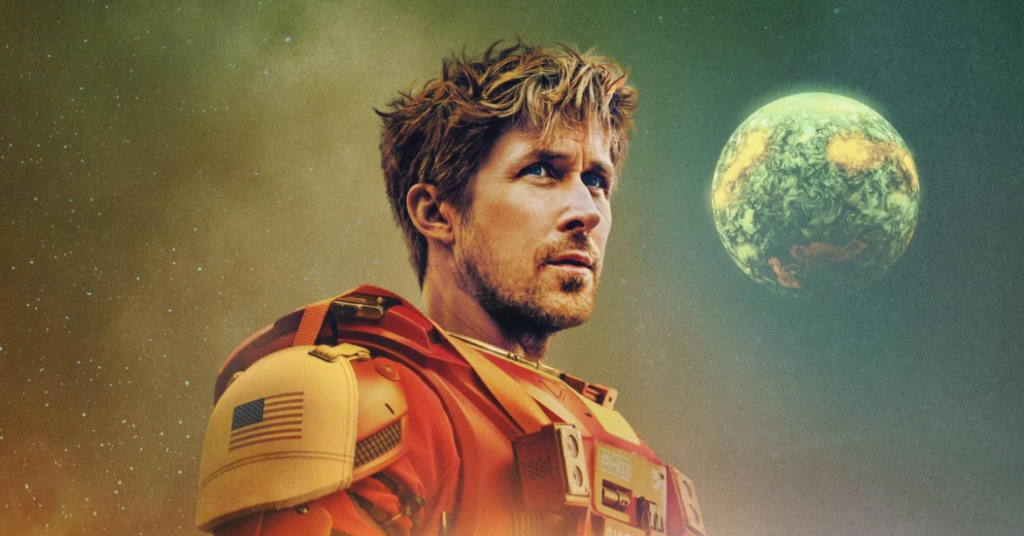
The bar for prestige science fiction in 2026 is extraordinarily high. The genre has had a remarkable run in recent years — from Christopher Nolan’s Interstellar to Denis Villeneuve’s two-part Dune adaptation to the ongoing influence of arrival-era thoughtful, ideas-driven filmmaking. Project Hail Mary arrives with source material that critics have called the best hard science fiction novel since Carl Sagan’s Contact, a star whose recent career has been defined by a willingness to take ambitious risks, and a studio in Amazon MGM that has demonstrated real appetite for prestige genre filmmaking.
What the film has going for it, above all, is specificity. Project Hail Mary is not a vague space epic about humanity’s destiny. It is a very specific story about a very specific man solving a very specific problem — and finding, in the process, something he did not know he was looking for. That specificity, in the best science fiction films, is what transforms spectacle into experience.
The release date — March 20, 2026 — places it outside the traditional blockbuster summer window, which suggests the studio is positioning it as a prestige event rather than a pure popcorn spectacle. That is the right call. Project Hail Mary deserves to be seen as what it is: not the next big action film, but the next great science fiction film.
Awards conversations will begin the moment the first reviews drop. They should.
Project Hail Mary opens in theaters worldwide on March 20, 2026, from Amazon MGM Studios. The novel by Andy Weir is available now wherever books are sold.
All film details and release information current as of March 21, 2026. Subject to change.
Estimated reading time: 9 minutes

1 Comment
Pingback: The Devil Wears Prada 2 - A Sequel Worth Waiting For - Glitterica