
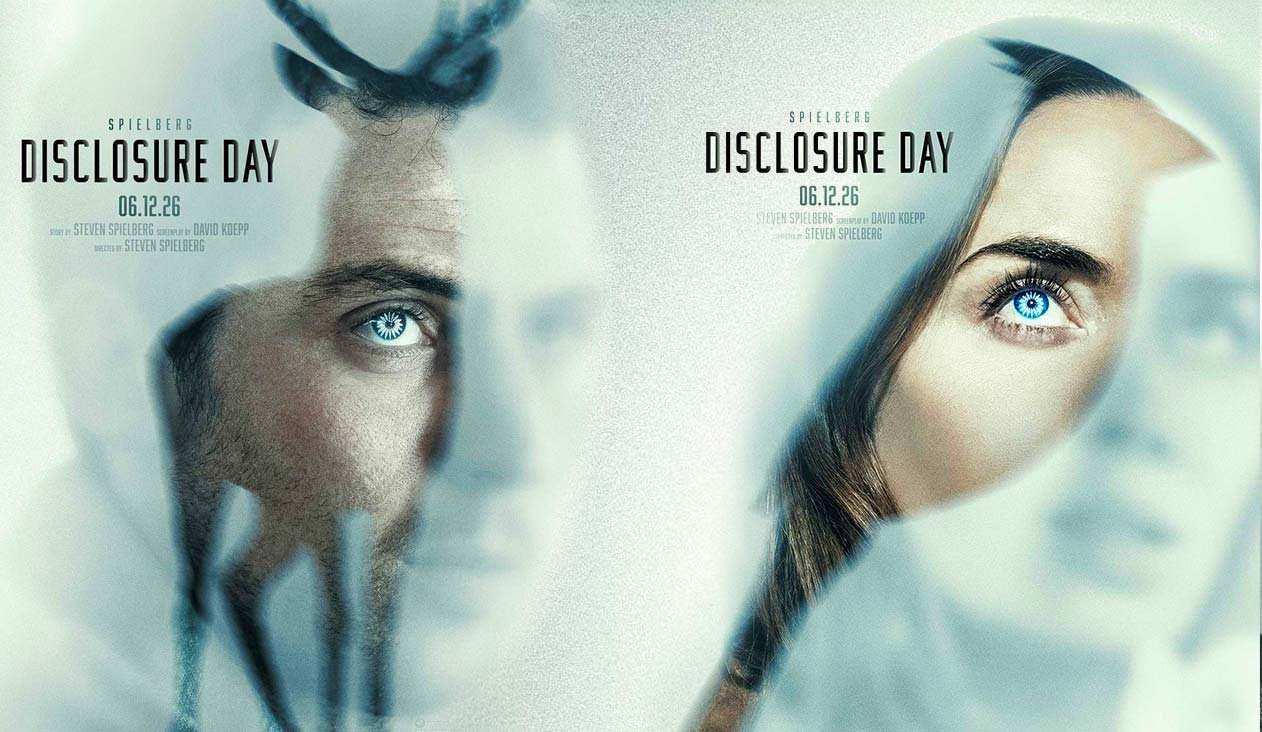
If you found out we weren’t alone — if someone showed you, proved it to you — would that frighten you?
That is the question Steven Spielberg wants you to sit with. It is the question printed on every piece of promotional material for Disclosure Day. It is the question that has had the internet arguing, theorizing, and obsessing since the film’s first teaser dropped in December 2025. And it is, if the trailers and everything we know about this film are to be believed, a question whose answer is far more complicated than either “yes” or “no.”
Disclosure Day arrives in theaters and IMAX on June 12, 2026, from Universal Pictures and Amblin Entertainment. It is the 37th film directed by Spielberg. It is his first since The Fabelmans in 2022. And it is, by every available measure, the most anticipated science fiction film of the year — a return, by the man who essentially invented the modern blockbuster, to the genre he has circled his entire career: what happens when humanity comes face to face with something it cannot explain and cannot control.
The difference, this time, is that the sky is not filled with wonder. It is filled with dread.
HOW DISCLOSURE DAY CAME TO BE: THE ORIGIN STORY
The road to Disclosure Day began quietly. In April 2024, reports emerged that Steven Spielberg was developing a UFO film based entirely on his own original idea — not an adaptation, not a franchise extension, but something conceived entirely from his own imagination. His longtime screenwriting collaborator David Koepp, who had worked with Spielberg on Jurassic Park, The Lost World, War of the Worlds, and Indiana Jones and the Kingdom of the Crystal Skull, was brought in to develop the screenplay.
Within weeks, the pieces fell into place with remarkable speed. By May 2024, Universal Pictures had signed on to distribute — continuing the studio’s decades-long relationship with Spielberg and Amblin Entertainment. In June, Emily Blunt entered early talks for the lead role. By August, her casting was confirmed. The rest of the ensemble assembled through the autumn: Colin Firth in August, Eve Hewson in September, Colman Domingo in October, and Wyatt Russell and Josh O’Connor joining by December.
Two members of the cast — Josh O’Connor and Henry Lloyd-Hughes — were offered their roles without having to audition. Spielberg simply told O’Connor the story and asked if he wanted to do it. Given O’Connor’s current standing as one of the most coveted actors in the world — off the back of Emmy and Golden Globe wins for The Crown, a scene-stealing turn in Challengers, and his recent performance in Wake Up Dead Man: A Knives Out Mystery — the gesture speaks volumes about how highly Spielberg valued him for the role.
The film was originally set for a May 15, 2026 release date before being shifted to June 12, a move that placed it squarely in the heart of the summer blockbuster season. No other studio appears to have any intention of going up against it on that weekend. Wise.
FILMING DISCLOSURE DAY: NEW YORK, NEW JERSEY, AND ATLANTA
Principal photography ran from February to May 2025, with production spread across three U.S. locations: New York, New Jersey, and Atlanta, Georgia. The choice to shoot entirely on American soil reflects the film’s fundamentally American premise — a story rooted in the mythology of Roswell, government secrecy, and the very particular cultural relationship the United States has with the idea of UFOs and extraterrestrial life.
The production was tight-lipped in ways that few major studio films manage in the age of social media. Spielberg and his team operated under a working title — The Dish — that sent fan theorists into overdrive the moment it leaked. Was it a reference to the massive satellite dishes in Close Encounters of the Third Kind? A nod to a government listening post? Spielberg wasn’t saying. Neither was anyone else.
The behind-the-scenes creative team is a gathering of Spielberg’s most trusted long-term collaborators. Oscar-winning cinematographer Janusz Kamiński — who has been Spielberg’s director of photography since Schindler’s List in 1993 and shot Saving Private Ryan, Munich, Lincoln, and The Fabelmans — brings his signature visual intelligence to the film. Production designer Adam Stockhausen, editor Sarah Broshar, and costume designer Paul Tazewell (making his second Spielberg collaboration after West Side Story) round out a crew of exceptional pedigree.
And then there is John Williams. The 93-year-old composer, widely considered the greatest film scorer in history, signed on to compose Disclosure Day’s score in October 2025 — making it his 30th collaboration with Spielberg. Their partnership, which began with The Sugarland Express in 1974, has produced some of the most iconic music in cinema history: Jaws, Star Wars, Raiders of the Lost Ark, E.T., Schindler’s List, and dozens more. The ratcheting, minor-key dread already audible in the trailers suggests Williams is operating in the register of his most unsettling work.
“John Williams’s score for Disclosure Day is his 30th collaboration with Spielberg. The ratcheting dread in the trailer suggests he is operating in the register of his most unsettling work.”
THE CAST: AN EXTRAORDINARY ENSEMBLE
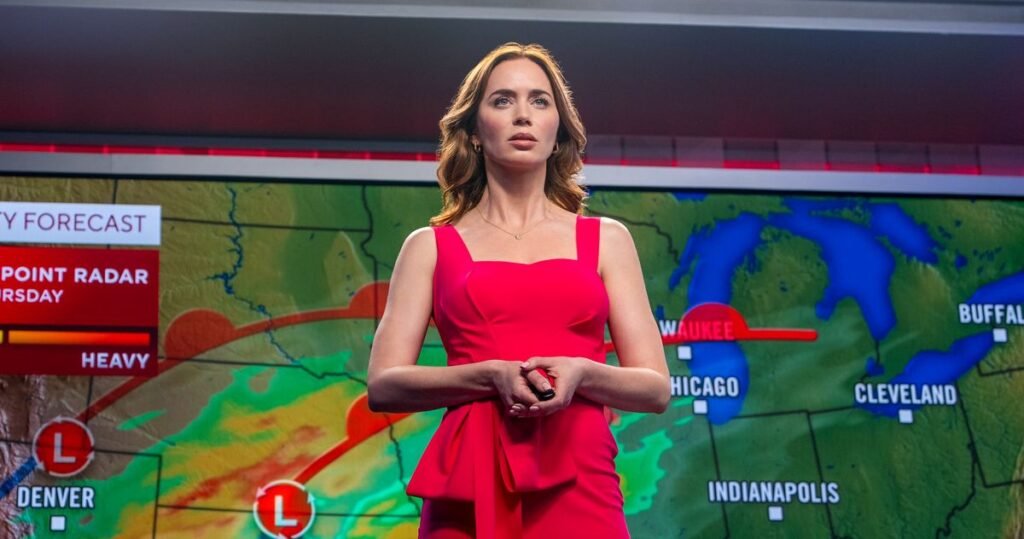
Disclosure Day assembles one of the most decorated casts of any 2026 film. At its center is Emily Blunt — SAG Award winner, Oscar nominee, and one of the most versatile actors of her generation — playing Sarah, a Kansas City television meteorologist whose live weather broadcast is suddenly, inexplicably hijacked by forces she cannot understand or control. Blunt has previous form in alien-adjacent territory, having starred in Edge of Tomorrow and the two A Quiet Place films. But Disclosure Day appears to place her in something far more grounded and personal: not a trained soldier or survivalist, but an ordinary woman at the centre of an extraordinary event.
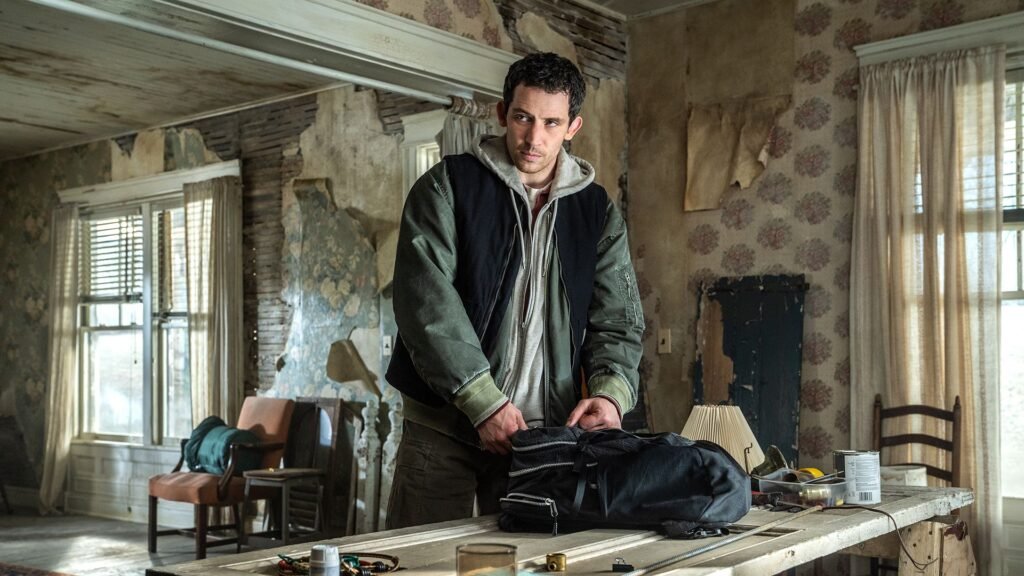
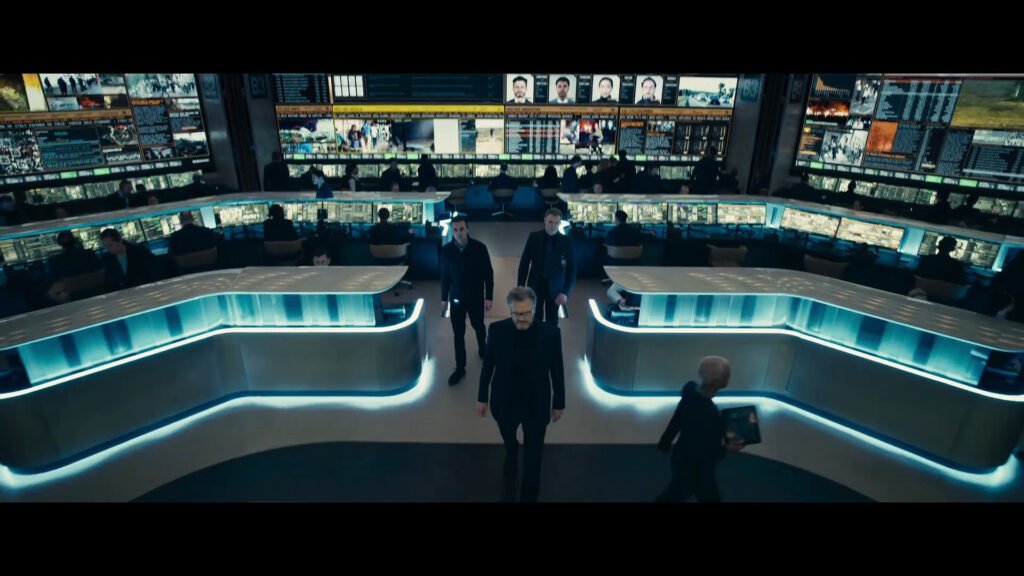
Josh O’Connor plays Daniel Kellner, a former cybersecurity administrator for a shadowy high-tech company called Wardex. Kellner has stolen data from his employer — data that contains long-suppressed government secrets about the existence of extraterrestrial life — and is determined to release it to the world. He is, in the language of the film, a whistleblower in the most literal and cosmic sense: a man who believes the truth about what is happening in the skies above Earth belongs to all seven billion people on it, not to the institutions that have spent decades burying it.
Colin Firth plays the film’s apparent antagonist: a figure of immense institutional authority who is equally determined to stop Kellner. In the trailer’s most chilling exchange, Firth’s character confronts O’Connor’s directly: “That truth will upend all established order across the entire world. If you do this, there’s no undoing it.” It is the voice of power defending power — the voice that has always argued, in every era, that the public cannot handle what the government knows.
Colman Domingo — a two-time Oscar nominee for Rustin and Sing Sing — plays a character who appears, from the trailer, to be the film’s conscience: a figure who has lived inside the secret for decades and has finally reached breaking point. “This 79-year terror campaign of lies has to end,” his character says with barely contained fury — a reference, almost certainly, to the 1947 Roswell Incident. Eve Hewson plays Jane, Daniel Kellner’s girlfriend, who asks the film’s most resonant secondary question upon learning what Kellner has stolen: “Are they people?”
The supporting ensemble includes Wyatt Russell, Henry Lloyd-Hughes, Elizabeth Marvel, Mckenna Bridger, and Michael Gaston — a cast of reliably excellent character actors assembled with care.
WHAT WE KNOW ABOUT THE PLOT OF DISCLOSURE DAY
Universal and Amblin have been extraordinarily disciplined about keeping the full plot of Disclosure Day under wraps — an approach that feels deliberately Spielbergian, harking back to the months before Jaws and E.T. opened and nobody quite knew what they were walking into. What the two trailers have revealed is enough to sketch the shape of the story, though the centre of it — the nature of the disclosure itself, and what it means — remains carefully obscured.
The film appears to operate on three interlocking narrative threads. The first is Kellner’s whistleblower mission: a cybersecurity expert turned fugitive, carrying stolen data about the reality of extraterrestrial life, racing to release it before Firth’s institutional forces can stop him. The second is Sarah’s involuntary transformation: a Kansas City meteorologist who begins, without explanation, to speak an alien clicking language live on air — a language that Kellner, crucially, can understand. The third is the historical reckoning embodied by Domingo’s character: the revelation that the 1947 Roswell Incident was not a weather balloon, that the cover-up has lasted nearly eight decades, and that the consequences of the truth coming out could reshape civilization.
The alien presence in the film appears to be both more intimate and more disturbing than the cosmic spectacle of Spielberg’s earlier extraterrestrial work. Rather than spaceships and light beams, we are shown strange animal behaviour — deer wandering into bedrooms, a cardinal behaving with uncanny intent, elk moving in unnatural formations — alongside the religious imagery of cardinals and nuns apparently reacting to something the secular world has missed. The aliens, it seems, have been communicating with Earth in ways that bypass institutions entirely, speaking instead through nature and faith.
And then there is the detail that has generated the most feverish online discussion: O’Connor’s character says the truth “belongs to seven billion people.” The Earth’s actual population in 2026 is over eight billion. That missing billion has become the focal point of a theory — seeded in part by a 2023 Spielberg interview with Stephen Colbert — that the film’s aliens may not be visitors from another galaxy, but humanity itself, 500,000 years in the future.
⚡ Fan Theory #1: A Secret Sequel to Close Encounters of the Third Kind
The working title was ‘The Dish’ — potentially referencing the government satellite dishes in Close Encounters. The June 12 release is timed to the 50th anniversary of that film’s theatrical run. The glowing UFOs, the strange animal behaviour before human contact, and the shadowy government cover-up are all Close Encounters DNA. When The Hollywood Reporter asked screenwriter David Koepp directly whether Disclosure Day was set in the same cinematic universe, he replied: “Like I’m going to answer that. Sorry, Woodward! You’re trying to trick me into confirming something I don’t want to confirm.” That is, in Hollywood terms, essentially a confirmation.
⚡ Fan Theory #2: The Missing Billion — Time-Traveling Humans
O’Connor’s character declares the truth “belongs to seven billion people” — but Earth’s 2026 population exceeds eight billion. In a 2023 Colbert interview, Spielberg speculated that UAPs might be “us, 500,000 years into the future — time-traveling anthropologists studying their own past.” If the ‘missing billion’ represents a future human population reduced by catastrophe, the aliens may not be alien at all. They may be us, watching.
⚡ Fan Theory #3: The Body Swapping Element
The second trailer hints at what appears to be body-swapping or consciousness transfer — Emily Blunt’s meteorologist speaking an alien language she doesn’t understand, while O’Connor’s character reveals he can. Colin Firth’s character appears connected to a sophisticated VR or neural-interface rig. Some theorists believe the aliens are not physically present but are communicating through human hosts — selectively, and with purpose.
SPIELBERG’S ALIEN LEGACY: FROM WONDER TO DREAD
To truly understand Disclosure Day, you have to understand the arc of Steven Spielberg’s relationship with extraterrestrial life across his career. It is not a straight line. It is something more complicated, more personal, and more reflective of how both the director and the culture around him have changed over fifty years.
Close Encounters of the Third Kind (1977) was pure awe. The aliens arrive in a cascade of light and music, communicating through tone rather than language, offering not threat but invitation. The film’s final image — Richard Dreyfuss ascending into the light — is one of the most transcendent endings in American cinema. It is a film made by a young director who looked at the sky with wonder and curiosity.
E.T. the Extra-Terrestrial (1982) was love. An alien stranded on Earth, befriended by a lonely child, threatened by the institutional authority of adults who cannot see what the child sees. The film’s famous image of a bicycle silhouetted against the moon has become synonymous with cinema itself. It is a film about the purity of connection across difference.
War of the Worlds (2005) was something darker. A planet under assault, ordinary people helpless and terrified, no communication possible, no understanding on offer. The aliens in War of the Worlds do not want to talk. They want to exterminate. It was Spielberg’s post-9/11 alien film, and it showed.
Disclosure Day appears to occupy a fourth register entirely: not wonder, not love, not terror — but reckoning. The film asks what it means to have been lied to for 79 years. What it does to the foundations of a civilization to learn that everything it was told about its place in the universe was carefully managed and controlled. That is a more grown-up question than any Spielberg has asked before in this genre. And it is precisely the question that the cultural moment — with real-world UAP hearings in Washington, declassified government files, and genuine public uncertainty about what is in the sky — is already asking.
“Not wonder. Not love. Not terror. Disclosure Day occupies a fourth register entirely: reckoning. What does it do to a civilization to learn it has been lied to for 79 years?”
THE TRAILERS: A MARKETING CAMPAIGN BUILT ON MYSTERY
Universal and Amblin have executed one of the most carefully calibrated marketing campaigns in recent memory. The teaser trailer — released on December 16, 2025 — was almost willfully obscure. It showed Emily Blunt’s meteorologist losing control on live television, speaking in a series of clicks and guttural sounds while her producers and viewers look on in horror. It offered no aliens, no spaceships, no exposition. Just a woman being overtaken by something incomprehensible, and a logline that asked a single question: “If you found out we weren’t alone, if someone showed you, proved it to you, would that frighten you?”
Two posters appeared simultaneously in Times Square and Los Angeles: a giant bird-shaped eye with the words “All will be disclosed,” followed by the June 12 release date. The bird imagery proved immediately significant to fans who began matching it to the strange cardinal and elk behaviour visible in the trailer — suggesting that the non-human intelligence in this film is communicating through nature as much as through technology.
The second trailer, unveiled during Super Bowl LX on February 8, 2026, was the one that broke the internet. Set against rising orchestral tension, it introduced Kellner’s whistleblower mission, Firth’s opposition, Domingo’s fury about Roswell, and the revelation that Kellner can understand the alien language coming out of Sarah’s mouth. It also contained the shot that critics and fans immediately identified as quintessentially Spielbergian: a small girl standing before a glowing house, filmed from her point of view — an angle Spielberg has used in Close Encounters, E.T., and across his career as a visual shorthand for the encounter between innocence and the incomprehensible.
The film’s tagline was updated to “This summer, everything will become clear” — a line that, given how much has been deliberately kept unclear, functions as both promise and provocation.
WHY DISCLOSURE DAY COULD BE THE FILM OF SUMMER 2026
There are several reasons to believe Disclosure Day will be more than just a commercial event. The first is the moment. The real-world discourse around UAPs has shifted dramatically in the past five years. Congressional hearings have featured credible witnesses describing craft that defy known physics. Declassified Pentagon footage has been authenticated. A former intelligence official testified under oath that the United States government possesses retrieved non-human vehicles. Whether any of this is true in the way it is being presented is a matter of serious debate — but what is not debatable is that the public conversation has changed, and Spielberg’s film lands directly into that change.
The second reason is the creative pedigree. This is not a franchise sequel, a remake, or a producer-driven commercial product. It is an original story, conceived by one of cinema’s greatest directors, written by one of its most reliable screenwriters, shot by one of its finest cinematographers, and scored by its most legendary composer. Every major creative decision on this film has been made by people who have earned the right to be trusted.
The third reason is the cast. Emily Blunt, Josh O’Connor, Colin Firth, and Colman Domingo are four of the finest actors working today, each at or near the peak of their powers. The combination of Blunt’s physicality and emotional intelligence, O’Connor’s repressed intensity, Firth’s authoritative menace, and Domingo’s volcanic moral clarity is not a cast assembled for marketing purposes. It is a cast assembled to carry genuine dramatic weight.
And the fourth reason is Spielberg himself. He is 79 years old. He has made 37 films. He has nothing left to prove and nothing left to fear. Disclosure Day is the film of a director who is looking at the sky with the full complexity of a lifetime of thought about what might be out there — and what it would mean for us to finally know. That is a film worth staying awake for.
Disclosure Day opens exclusively in theaters and IMAX on June 12, 2026, from Universal Pictures and Amblin Entertainment.
All production details and cast information are current as of March 21, 2026. This article will be updated as new information becomes available.
Key Takeaways
- Steven Spielberg’s film Disclosure Day 2026 raises profound questions about humanity and extraterrestrial life.
- Filming took place in New York, New Jersey, and Atlanta, with a star-studded cast led by Emily Blunt and Josh O’Connor.
- The plot revolves around a whistleblower revealing government secrets about extraterrestrial existence, exploring themes of trust and control.
- The film builds anticipation with a mysterious marketing campaign and impactful trailers, hinting at deep societal implications.
- With its original story and powerful cast, Disclosure Day 2026 stands as a significant cultural commentary amidst a shifting discourse on UFOs.
