


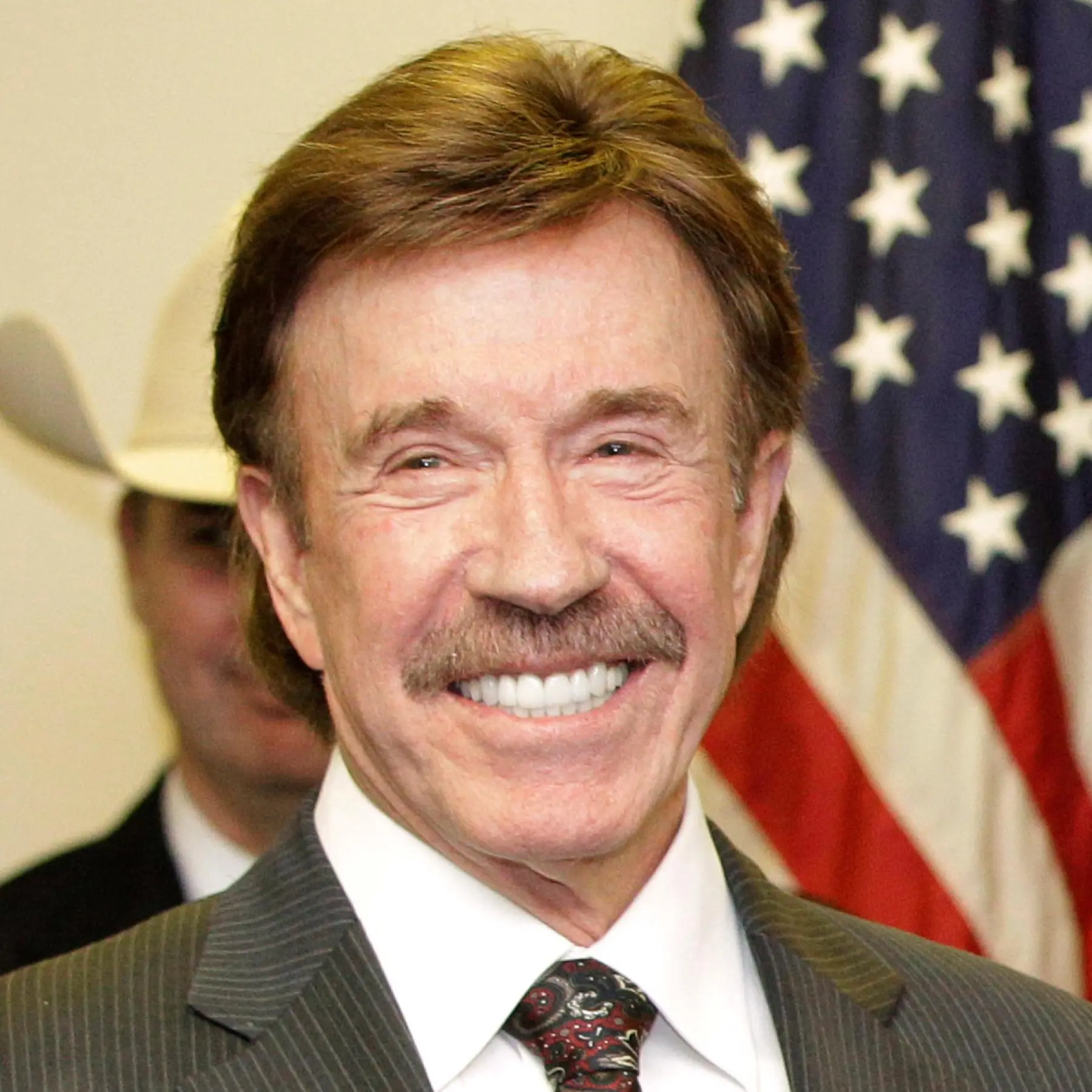
Chuck Norris, the martial arts champion and karate instructor who became one of Hollywood’s defining action stars of the 1980s and later starred in the beloved CBS drama Walker, Texas Ranger, died Thursday in Hawaii. He was 86. News of the Chuck Norris death was confirmed by his family, who announced that he passed away suddenly after being hospitalized, noting that he was “surrounded by his family and was at peace.”
“He lived his life with faith, purpose, and an unwavering commitment to the people he loved,” his family said in a statement. “Through his work, discipline, and kindness, he inspired millions around the world and left a lasting impact on so many lives. To him, you were not just fans — you were his friends.”
The family asked that the circumstances of his death be kept private.
Few action stars of any era could claim the authenticity that Norris brought to the screen. Unlike contemporaries who merely played fighters, Chuck Norris was one — a holder of black belts in karate, Tang Soo Do and taekwondo, a man with a competitive record of 65 wins and 5 losses, six world karate championships to his name, and a personal training partnership with Bruce Lee. He didn’t need a stunt double. He was the stunt double.
Who Was Chuck Norris? Early Life and Background
Born Carlos Ray Norris on March 10, 1940, in Ryan, Oklahoma — a small town near the Texas border — Chuck Norris grew up in poverty under difficult circumstances. His father, Ray, worked as a mechanic and trucker but struggled with alcoholism, frequently abandoning the family for extended periods. His mother, Wilma, worked odd jobs to keep the household afloat.
“Genetically speaking, I am equal parts Irish and Native American,” Norris wrote in his 2004 memoir, Against All Odds: My Story. He was the eldest of three boys. The family’s middle son, Wieland, would later be killed in action during the Vietnam War.
With no stable male presence at home, young Carlos found his role models at the local movie theater: John Wayne, Gene Autry, and Roy Rogers. Their onscreen code — loyalty, integrity, and protecting the innocent — left a permanent mark. “I determined that I would grow up one day to be like them,” he wrote. Years later, he would consciously shape his own screen persona around those same Western ideals.
The Norris family eventually settled in Southern California around 1950. After graduating from North Torrance High School, Chuck enlisted in the United States Air Force. A fellow serviceman gave him the nickname “Chuck” while he was stationed at Osan Air Base in South Korea, and it stuck for the rest of his life.
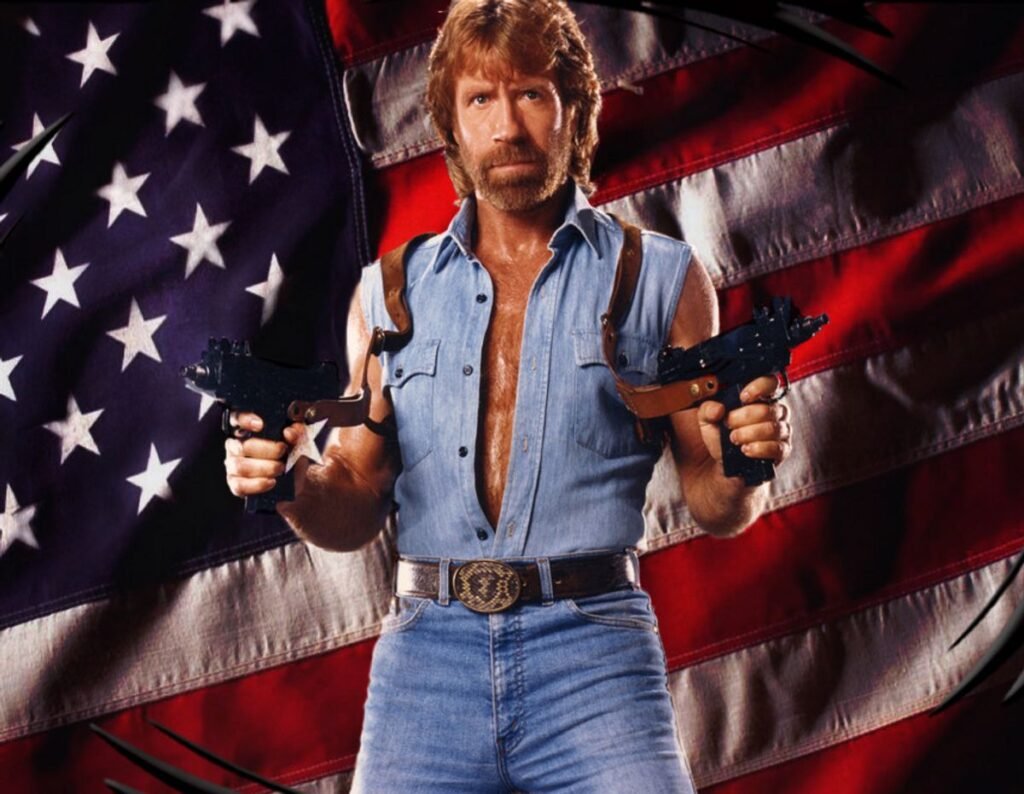
Chuck Norris’s Martial Arts Career: Black Belts, Championships, and Bruce Lee
It was in South Korea that Chuck Norris discovered martial arts. While serving as a military policeman, he began studying judo and Tang Soo Do — a Korean discipline that uses feet and hands as weapons. He took to it with an intensity that would define the next chapter of his life.
After his military discharge in 1962 — by which point he held a first-degree black belt in Tang Soo Do and a third-degree brown belt in judo — Norris worked days as a file clerk at defense contractor Northrop Corp. and taught karate classes in his mother’s backyard by night. He took out a loan to open his first karate school in Torrance, California, and began competing professionally. Over time, he earned black belts in multiple disciplines and created his own hybrid fighting system, Chun Kuk Do, blending elements of the various martial arts he had mastered.
His competitive record was formidable: a reported 65-5 win-loss ratio and six world karate championships. He retired from competition in 1974, undefeated at the top level. But perhaps the most famous chapter in his martial arts story was his friendship and collaboration with Bruce Lee.
The two met at a karate tournament at Madison Square Garden in 1967 and developed a genuine friendship. Lee later hired Norris as an adviser and small-role actor on various projects, before the two reunited for what became one of the most celebrated fight sequences in martial arts cinema: their one-on-one brawl inside the Roman Colosseum in The Way of the Dragon (1972). For fans of martial arts film, it remains a landmark moment — two grandmasters going head-to-head on screen.
Among Norris’s private students over the years were Bob Barker (who reportedly broke a couple of Norris’s ribs during one session), Priscilla Presley, and Steve McQueen — who would ultimately change the course of Norris’s career.
Chuck Norris Movies: From Cannon Films to Hollywood Stardom
When Chuck Norris retired from competition in 1974, it was Steve McQueen who pushed him toward acting. “You either have a certain presence that comes across on the screen, or you don’t,” McQueen told him. “I think you may have it. I strongly suggest that you give it a try.”
Norris started modestly — small fight sequences in Slaughter in San Francisco (1974), a starring role as a trucker in Breaker! Breaker! (1977), and a lead part in Good Guys Wear Black (1978), which turned a modest profit. But his true breakthrough arrived with Lone Wolf McQuade in 1983, a Sergio Leone-inspired Western action film in which he played a gruff Texas Ranger going up against an arms-dealing martial arts expert played by David Carradine. The film established his screen persona: the quiet loner who would rather be left alone, but who was absolutely devastating when pushed.
The role earned him a deal with the Cannon Group — the scrappy, prolific mini-studio run by Israeli producers Menahem Golan and Yoram Globus. What followed was one of the most commercially successful runs in action movie history, even if critics were rarely enthusiastic. Chuck Norris movies from this era include:
• Missing in Action (1984) — Norris as Col. James Braddock, a POW who returns to Vietnam to rescue soldiers. Critically panned, enormously popular with audiences, and spawned two sequels.
• Code of Silence (1985) — Widely considered one of his best films, praised even by critics for its gritty Chicago setting.
• Invasion U.S.A. (1985) — A Cold War action spectacle with Norris as a retired CIA operative defending America from a Soviet-backed invasion.
• The Delta Force (1986) — Inspired by real-world terrorism events, it became one of Cannon’s biggest international hits.
Norris was philosophical about the critical reception. He often recalled McQueen’s advice: “The critics can praise you to the end of the world, but if your movie makes $2, you’re not going to work. So as long as people come and see your movies, you’re going to keep working.” People kept coming.
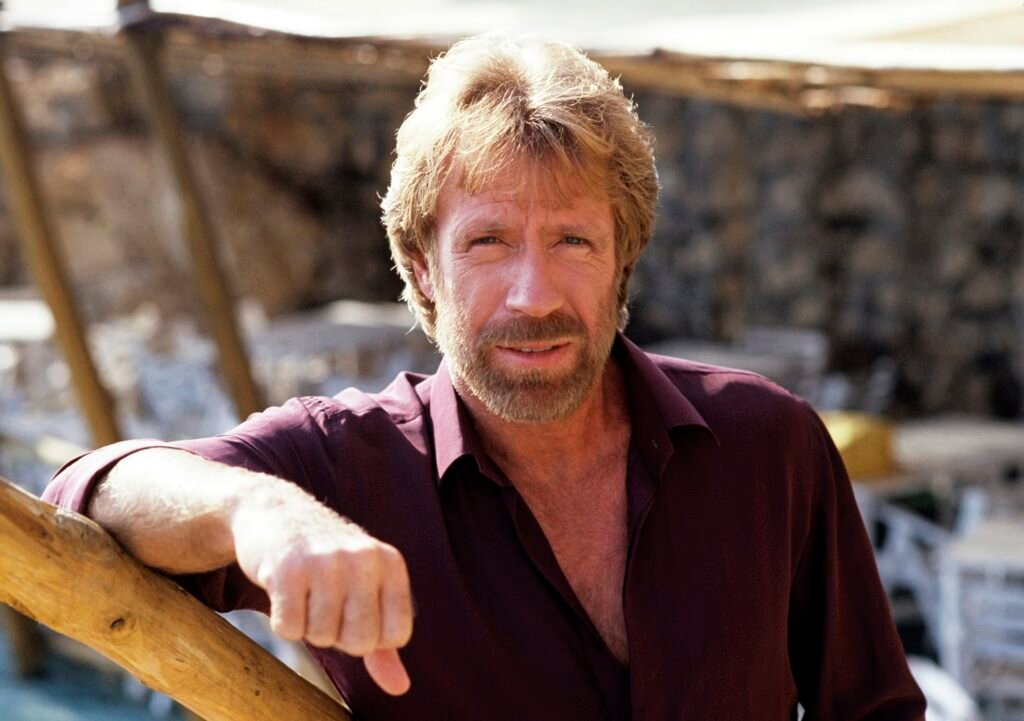
Walker, Texas Ranger: Chuck Norris’s Defining Television Role
Chuck Norris had turned down roughly a dozen television offers before the right one came along. Walker, Texas Ranger, created by Al Ruddy, Leslie Greif, Paul Haggis and Christopher Canaan at Cannon Television, debuted on CBS in April 1993 and ran for nine seasons, accumulating approximately 200 episodes and a 2005 telefilm.
Norris played Cordell Walker, a soft-spoken U.S. Marine-turned-Texas Ranger who dispensed justice with quiet conviction and, when necessary, exceptional force. The show aired on Saturday nights on CBS — the same slot and network that had once hosted Gunsmoke — and its modern Western sensibility resonated powerfully with audiences across the country.
“I liked the idea of a modern-day Western story,” Norris said. “It had the action that I wanted, it had the inner relationships with the people that are necessary for a series, and it had the humor with the characters that I was involved with.” The show consistently drew tens of millions of viewers and became one of the most-watched dramas of the 1990s.
Walker, Texas Ranger’s legacy extended well beyond its original run. The CW launched a reboot in December 2020, starring Jared Padalecki, which ran for four seasons. And in 2023, Norris settled a lawsuit against CBS and Sony Pictures in which he alleged he had been shortchanged at least $30 million in profits from the original series.
Chuck Norris Facts: How a Meme Became a Monument
Perhaps no other action star of the pre-social-media era became so thoroughly mythologized in the digital age. The “Chuck Norris Facts” meme — a series of deadpan, hyperbolic jokes about his superhuman toughness — spread virally across the early internet in the mid-2000s and transformed him into a global cultural shorthand for indestructibility.
Examples ranged from the playful (“When Chuck Norris crosses the street, the cars look both ways”) to the absurd (“People wanted to add Chuck Norris to Mount Rushmore, but the granite wasn’t tough enough for his beard”) to the existential (“When the boogeyman goes to sleep, he checks his closet for Chuck Norris”). Norris himself found the phenomenon amusing and occasionally contributed to it.
The meme gave him a second wind of cultural relevance with younger generations who might not have grown up watching Missing in Action or Walker, and it cemented his status not just as an actor but as an archetype.
Author, Activist, and Founder: Chuck Norris Beyond the Screen
Chuck Norris’s life extended well beyond film and television. He was a prolific author, writing multiple books including The Secret of Inner Strength (1987), The Secret Power Within: Zen Solutions to Real Problems (1996), and Black Belt Patriotism (2008), which touched on his conservative political views and Christian faith. He also wrote a memoir, Against All Odds: My Story (2004), which traced his journey from Oklahoma poverty to global stardom.
In 2005, he founded the World Combat League, a team-based full-contact martial arts competition that sought to bring the sport to mainstream television audiences. He also starred in the animated syndicated series Karate Kommandos (1986) and appeared in two President’s Man telefilms for CBS. Later career appearances included Dodgeball: A True Underdog Story (2004) and The Expendables 2 (2012), in which he joined an ensemble of action legends.
His younger brother Aaron Norris, a stuntman and martial artist, directed and produced numerous episodes of Walker as well as several of Chuck’s theatrical films — a family creative partnership that spanned decades.
Chuck Norris’s Personal Life: Family, Faith, and Resilience
Chuck Norris married twice. His first marriage ended in divorce. In 1998, he married Gena O’Kelley, and the two remained together until his death. He spoke frequently about the role of Christian faith in his life and credited it as a source of the discipline and moral grounding that shaped both his personal conduct and his screen characters.
He is survived by his wife Gena and his five children: Mike, Dina, Eric (a stunt coordinator and Walker director), Danilee, and Dakota. His brother Aaron also survives him. The family’s middle son, Wieland Norris, was killed in Vietnam — a loss that profoundly affected Chuck throughout his life.
In his later years, Norris largely withdrew from the public eye to care for Gena, who had suffered serious health complications. He was known among those close to him as a devoted husband and father, and his faith community remembered him as generous and sincere.
Chuck Norris’s Legacy: What He Meant to Action Cinema and American Culture
Chuck Norris arrived in Hollywood at exactly the right moment. The late 1970s and 1980s were a golden age for a particular kind of American action hero — stoic, physically formidable, morally uncomplicated — and Norris embodied that archetype as credibly as anyone. Unlike his contemporaries Sylvester Stallone and Arnold Schwarzenegger, who built their images partly on fictional characters (Rocky, the Terminator), Norris’s persona was a direct extension of who he actually was: a working-class kid from Oklahoma who had earned everything through discipline and hard work.
His films were not acclaimed for their artistry, but they were honest about what they were: crowd-pleasers built on action, patriotism, and the satisfying fantasy of the good guy winning. In an era of national anxiety — Vietnam, the Cold War, rising crime — his movies offered a kind of moral clarity that audiences found deeply reassuring.
“When you are fighting good against evil, when the good guys are taking on the bad guys and winning, then I think that’s good,” he said in a 1990s interview. “Unfortunately in our society, in reality, that’s not always the case. … It’s nice to be able to do movies where people say, ‘This is what should happen, this is the way it should be in real life.’ That’s why I think I’m so successful.”
He was right. And by the measure that mattered most to him — the loyalty of an audience that felt seen — Chuck Norris was one of the most successful entertainers of his generation.
Chuck Norris is survived by his wife, Gena O’Kelley Norris; his children Mike, Dina, Eric, Danilee, and Dakota; and his brother Aaron. He was 86.
